Where the firm started
This practice handles Express Entry, family sponsorship, work and study permits, inadmissibility and humanitarian applications. The lawyers were strong. The website read like a brochure: a few broad pages tried to cover every program, so Google had no reason to rank it for anything in particular.
- Catch-all service pages competing for dozens of unrelated programs
- No parent and child structure between pathways
- Thin coverage of refusals, inadmissibility and humanitarian cases
- Internal links that led nowhere useful
- No clear path from a guide to a consultation
What the rebuild had to deliver
- Architecture based on how people search, not internal practice group names
- A dedicated page for every major pathway
- Supporting content that proves depth in each cluster
- Layouts that make eligibility rules easy to scan
- Conversion options for every stage, from a quick question to full representation
What we did
- Step 1 and 2
Research and architecture
Service priorities, competitor structures, client questions and local demand mapped into four clusters: permanent residence, temporary residence, complex cases and local relevance. Each cluster got a hub, subpages and FAQs, with internal links planned before writing.
- Step 3 and 4
Rebuild and content
New navigation and page hierarchy from discovery to consultation. Key pages rewritten so headings, examples and FAQs reinforce one topic, with eligibility, process, documents and risks placed where readers start to worry.
- Step 5 and 6
Technical work and iteration
Crawlability, metadata, headings, internal links, mobile usability and schema tightened page by page. Search Console data then showed where the site was gaining traction, and those pages were widened and refined.
The results
Search Console results
Comparing the latest three months with the three months before: organic clicks rose from 181 to 3,020 and impressions from 15,400 to 373,000. Average CTR moved from 1.2% to 0.8% and average position from 6.5 to 7.3, both normal when a site suddenly appears for hundreds of new queries, and the average stayed on page one.
Paid search for the same practice area
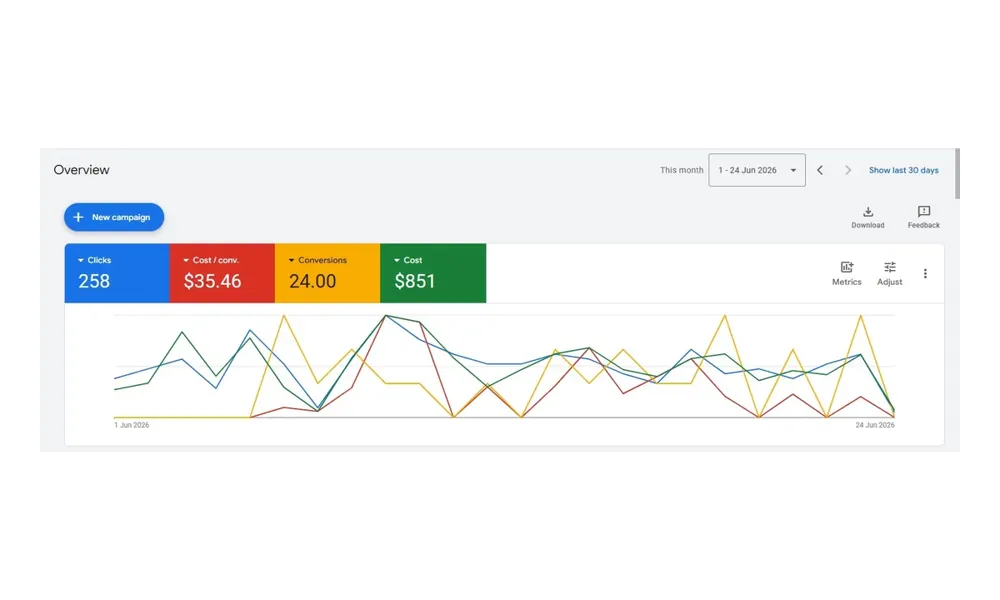
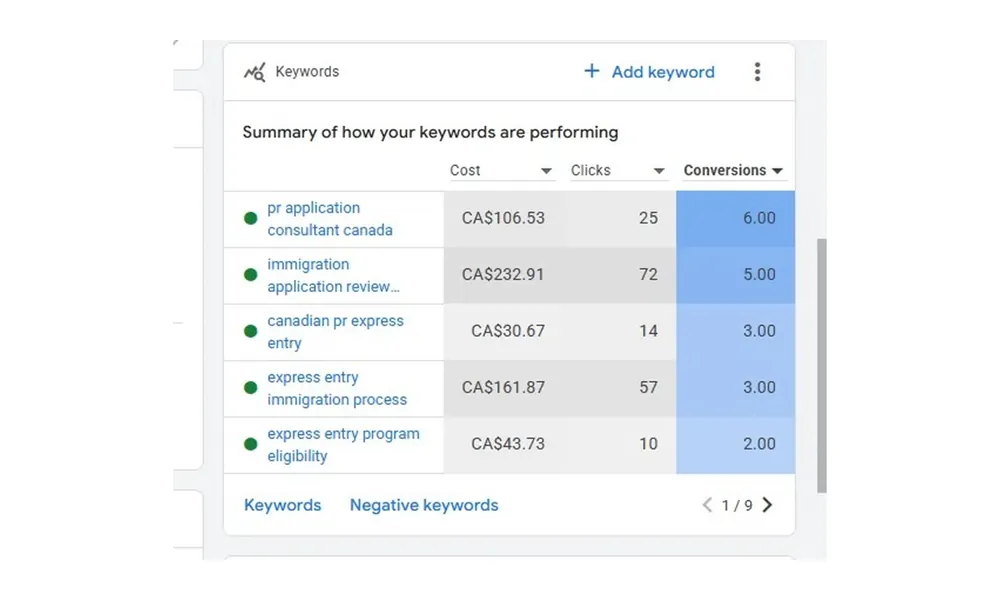
A separate immigration Google Ads campaign produced 24 tracked conversions on $851 in its first 24 days: 13 phone calls, 8 lead forms and 3 outbound clicks, with PR application and Express Entry terms converting best.
| Metric | Previous 3 months | Latest 3 months | Change |
|---|---|---|---|
| Organic clicks | 181 | 3,020 | +1,568% |
| Impressions | 15.4K | 373K | +2,322% |
| Average CTR | 1.2% | 0.8% | Wider query reach |
| Average position | 6.5 | 7.3 | Held on page one |
Every figure here comes from Google Search Console, which counts clicks rather than unique people. No link schemes, doorway pages or shortcuts were used. The growth came from structure, depth, clarity and steady iteration.
Before and after
Before
- Brochure-style site with a few broad pages
- Programs competing on the same URLs
- Thin coverage of high-intent searches
- No path from reading to booking
After
- 3,020 organic clicks a quarter
- 373K impressions, up 24x
- A page for every major pathway
- Clear routes from guides to consultations
What this means for Alberta law firms
Alberta immigration practices face the same challenge with one advantage: Alberta's own nomination program gives you a set of searches that national competitors usually cover poorly. We build the same topical map, add the Alberta Advantage Immigration Program streams and connect them to Calgary, Edmonton and the communities where your clients live and work.
Results depend on practice area, market and competition. Past results for one firm are not a promise of the same outcome for another. Estimated revenue figures use the close rates and case values stated above.